
Quick answer
Tint Station does car audio installation in its shop at 236 SW 12th Ave, Deerfield Beach, FL 33442, just west of I-95, for drivers across Broward and Palm Beach counties. You hear the options on the showroom demo walls, get a free quote, and drop the vehicle off. We install CarPlay and Android Auto head units, speakers, subwoofers, amplifiers and DSPs, keep factory features working and tune every system before pick-up.
What does car audio installation include at Tint Station?
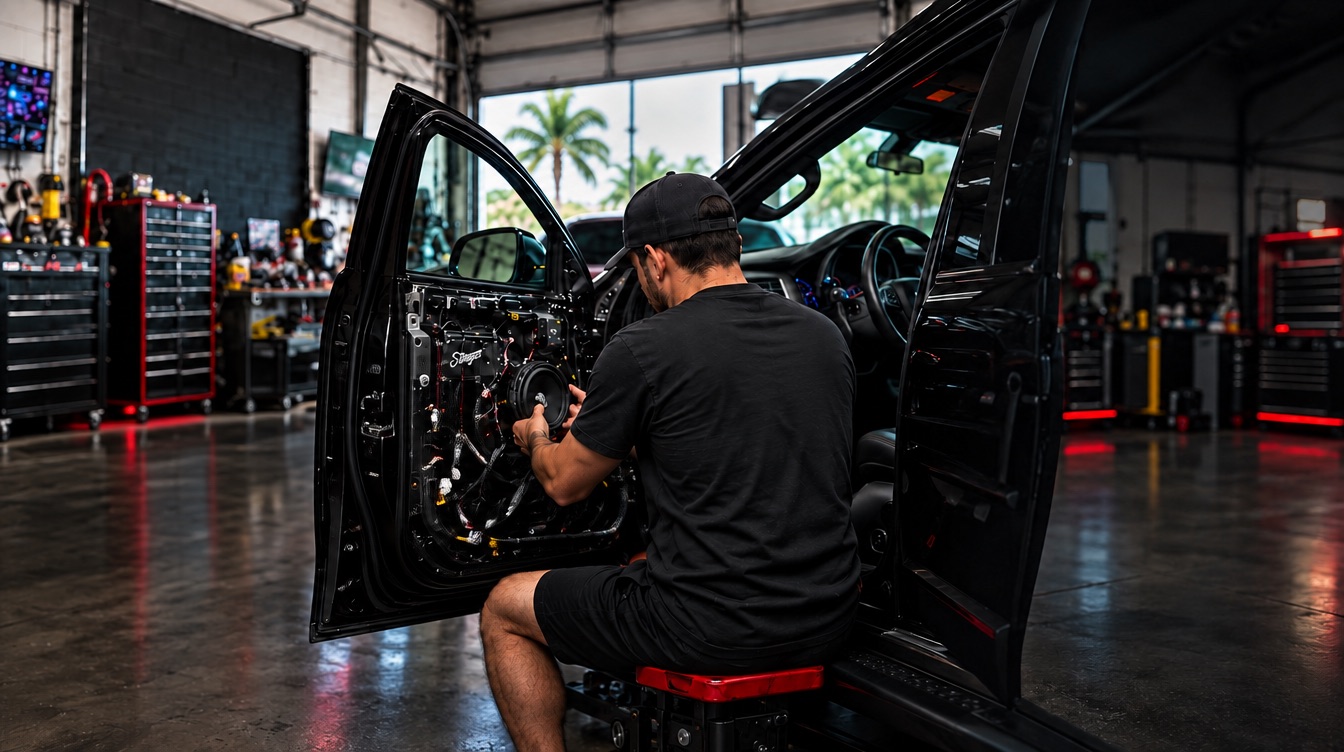
Car audio installation at Tint Station is the full job, not just a box swap: a consult, a showroom demo, a system design, the install in our Deerfield Beach bays, a tune from the driver’s seat and a walk-through before you leave. It covers head units, speakers, subwoofers, amplifiers, digital signal processors, sound deadening and custom enclosures, plus the factory integration that keeps your car working the way it did.
You can start small or go all the way. Many drivers come in for a touchscreen radio with Apple CarPlay or Android Auto. Others want a complete system: component speakers up front, an amplifier, a subwoofer in a custom box and a DSP to tune it. Either way, every part is chosen to work with the others, so the next stage is an add-on rather than a redo.
What every install includes
Vehicle-specific dash kits and wiring harnesses, power runs fused near the battery, solid grounds, wiring routed away from moving parts and sharp edges, panels refitted without new rattles, and a final tune at real listening volume.
The shop is owner-run. Ramsey has spent more than 20 years in car audio and vehicle customization, and the same standard applies to a radio swap and a full custom build. Tint Station also has a sister shop, Detroit Sound Station, in Detroit.
Read on for each part of the system, or go straight to the car audio quote page. For one-off enclosures and show builds, see custom car audio.
Free car audio quotes. Call (754) 227-5156.
Free quotes • Showroom demos • Owner-run for 20+ years
Can you add Apple CarPlay or Android Auto and keep factory features?
Yes, on most vehicles. A replacement head unit with Apple CarPlay or Android Auto fits the dash with a vehicle-specific kit, and an interface module translates factory signals so the new radio understands them. That is how steering-wheel controls, backup cameras, factory chimes and in many cases factory amplifiers keep working after the upgrade.
- Touchscreen head units: CarPlay and Android Auto, wired or wireless, with navigation and Bluetooth calling.
- Steering-wheel controls: retained with the correct interface for the vehicle.
- Cameras: factory backup cameras retained, or a new camera added to a car that never had one.
- Older cars: single-DIN and double-DIN screens bring phone integration to vehicles built before it existed.
- Newer cars with integrated screens: we look at interfaces that add phone integration while keeping the factory display.
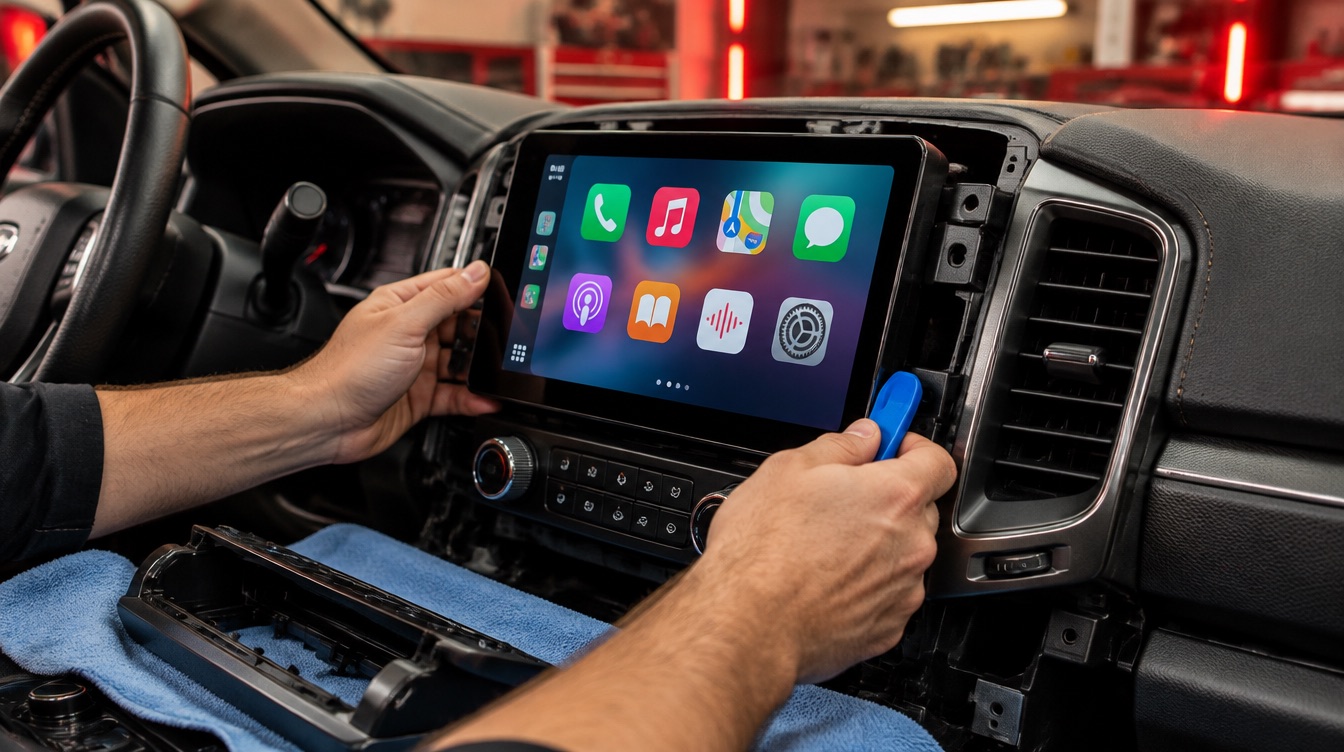
Hands-free is a safety upgrade as much as a convenience. NHTSA’s distracted driving guidance warns against handling a phone while driving, and a dash-mounted screen with voice control keeps maps, calls and messages in your line of sight. On a busy stretch of I-95, that matters.
If a factory feature cannot be carried over on your vehicle, we tell you at the consult, not after the install. Compare the platforms in our CarPlay vs Android Auto stereo guide, and see the dash camera guide if you want recording as well.
Component or coaxial: which car speakers should you choose?
Factory speakers are usually the weakest link in a car’s sound. Replacing them is the single biggest improvement in clarity for most drivers, and the choice comes down to two designs: component speakers and coaxial speakers.
| Component speakers | Coaxial speakers | |
|---|---|---|
| Design | Separate tweeter, woofer and external crossover | Tweeter mounted on the woofer in one unit |
| Sound | Better imaging; vocals sit higher, near ear level | Clear upgrade over factory, simpler presentation |
| Install | Tweeter mounted on the door, dash or pillar; more labor | Drop-in replacement in most factory locations |
| Best for | Front doors and dash in a full system | Rear doors, simpler upgrades, tight mounting spaces |
| Pairs with | An amplifier and DSP tuning | Factory or aftermarket head-unit power, or a small amp |
Most systems we design use components up front and coaxials in the rear. Proper mounting adapters matter as much as the speaker: a speaker that seals against the door panel sounds fuller and does not buzz, and sound deadening on the door skin turns a thin metal door into a better enclosure.
You can hear the difference on the showroom wall before you choose. For a deeper guide, read how to select car speakers, and if you drive a pickup, the best speaker upgrade for trucks covers cab-specific options.
Subwoofers, enclosures and amplifiers: how do they work together?
A subwoofer reproduces the lowest notes in music, the range door speakers are too small to play cleanly. Taking that work off the doors also lets them play mids and vocals more clearly, so a sub improves the whole system, not just the bass.
Enclosures
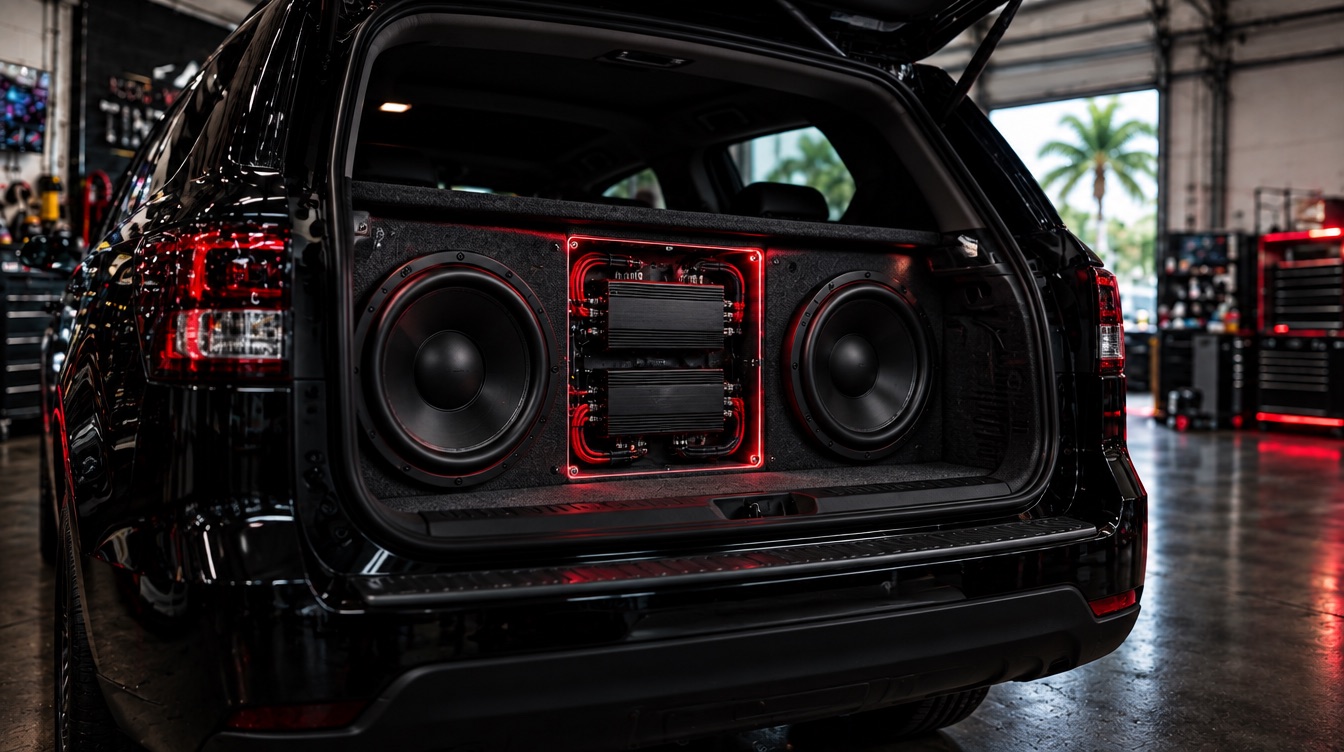
The box matters as much as the sub. Sealed enclosures give tight, accurate bass; ported enclosures play louder with fewer watts. We build custom enclosures to fit the space you can give up, whether that is a trunk, an SUV cargo area or the narrow space behind a truck seat, and we also fit compact and under-seat options where room is tight.
Amplifiers
An amplifier gives speakers clean power and headroom, so music stays clear at highway volume instead of distorting. An amp can power factory speakers to make them sound fuller, or drive aftermarket components and a sub. Correct installation is what keeps it reliable: the right cable gauge, a fused power run near the battery, a solid ground and a remote turn-on lead so it only draws power while the system is on.
Electrical capacity
Larger systems can need electrical upgrades to keep voltage stable. We check that during the consult and tell you if your plan needs it, rather than finding out after the lights dim on a bass note.
For more detail, read our car amplifier buying guide and the car audio installation mistakes worth avoiding.
What do DSP tuning and sound deadening add?
A digital signal processor, or DSP, controls what each speaker plays and when. It sets crossovers so tweeters, mid-woofers and the sub each get the right frequencies, applies equalization to smooth the peaks a car cabin creates, and uses time alignment so sound from the far door reaches you with the near one. The result is a centered sound stage in front of the driver.
Many factory systems also ship with an equalization curve built in. A DSP can correct it before the signal reaches new amplifiers, which makes it one of the most useful parts for drivers who want to keep the factory radio.
Sound deadening is the physical half. Damping material on door skins, floors and trunk panels stops sheet metal from vibrating, so rattles disappear and road noise drops. Doors that behave like solid enclosures also give speakers stronger mid-bass. We apply it while panels are already off for the install, which saves a second teardown later.
- Crossovers: each speaker plays only the range it handles well.
- Equalization: evens out peaks and dips from glass and upholstery.
- Time alignment: centers the image on the driver’s seat.
- Door and floor treatment: fewer rattles, lower road noise, tighter bass.
Tuning is the last step of every install, done from the driver’s seat at the volume you actually use. A tuned, treated car sounds clear at moderate volume, which is the most practical way to protect your hearing on long drives.
How do the showroom demo and the in-shop install work?
Every car audio installation follows the same five steps, and the first one costs nothing. Here is what to expect from the first call to the drive home.
- Consult. Call (754) 227-5156, use the quote page or walk in. Tell us the vehicle, how you listen and what bothers you about the current sound.
- Showroom demo. Hear speakers, subwoofers, amplifiers and head units on the display walls in the showroom, which include Kicker and Kenwood displays.
- Design and quote. We plan the parts, wiring, enclosure and factory integration, and give you a clear quote before anything is scheduled.
- Install in our bays. You drop the vehicle off at 236 SW 12th Ave in Deerfield Beach. Simple radio swaps are often same-day; full custom builds take longer and are scheduled after a design consult.
- Tune and walk-through. Gains, crossovers and equalization are set from the driver’s seat. We pair your phone, explain the controls and answer questions.
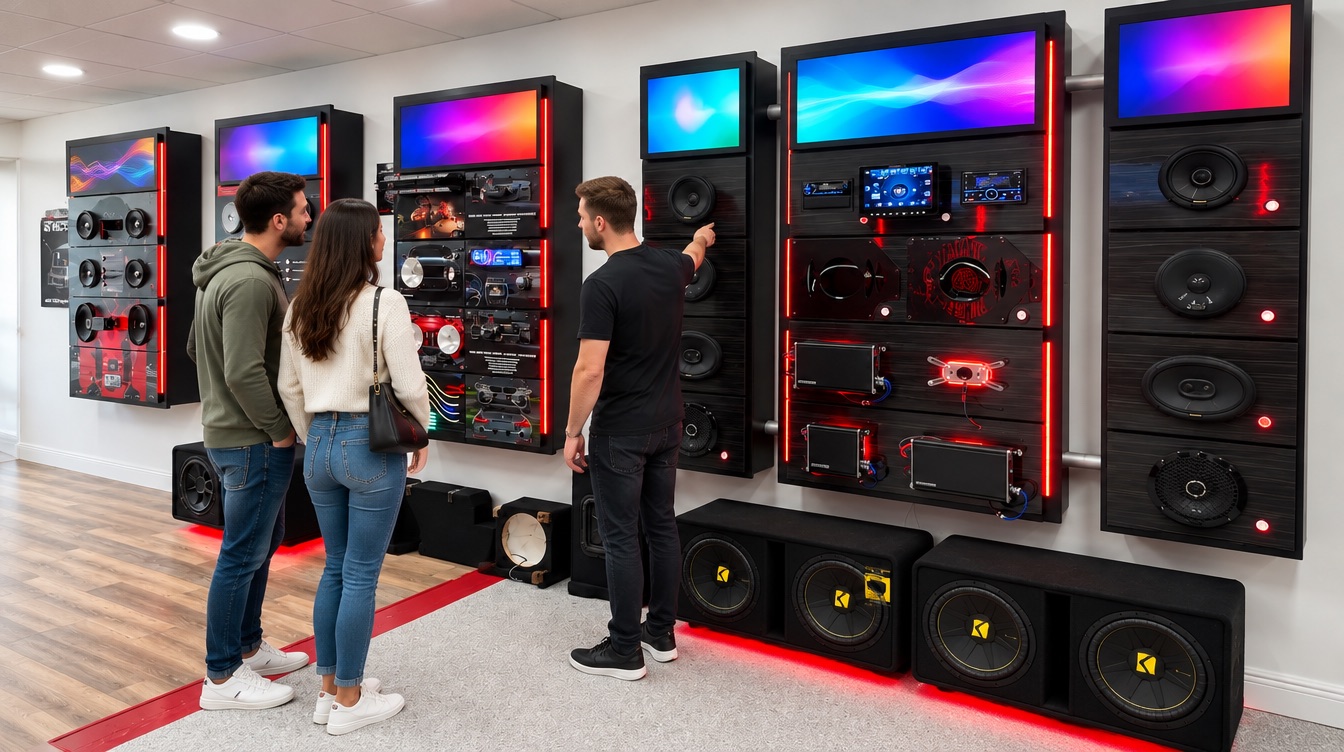
All work is done in the shop, never in a driveway or parking lot, because a clean install needs the right tools, lighting and time. We stand behind our installation work, and the shop is open every day from 10:00 AM to 7:00 PM, so drop-off and pick-up fit around a working week.
What does Florida law say about loud car stereos?
Florida Statute 316.3045 restricts amplified sound from a motor vehicle that is plainly audible at a distance, with some exceptions, and many cities and counties add their own noise ordinances on top. The practical advice is simple: check the local ordinance where you live and park, and keep the volume reasonable in neighborhoods, parking lots and near schools and hospitals.
Hearing is the other reason to keep it sensible. The NIDCD explains that long or repeated exposure to sound at or above 85 decibels can cause hearing loss, and the CDC’s NIOSH noise program covers how exposure time and level add up. A car is a small space, so level builds quickly.
Our approach
We design systems to sound full and clear at moderate volume. Good speakers, clean power, sound deadening and DSP tuning deliver detail without needing extreme levels, and we cover sensible volume at every walk-through.
None of that stops you from building a system with real impact. It means the impact comes from accuracy and clean bass rather than distortion, which is better for the car, the neighbors and your ears.
Where we install: Broward and Palm Beach County
Car audio customers come to the Deerfield Beach shop from every corner of both counties because it sits just west of I-95, between the Hillsboro Boulevard and SW 10th Street exits, right on the county line. Below are the two county hubs and every city page, each with the real drive time to the shop.
Car audio installation in Broward County
Fort Lauderdale, Pompano Beach, Coral Springs, Hollywood and the rest of Broward: up to 50 minutes via I-95, the Sawgrass Expressway or Florida’s Turnpike.
Car audio installation in Palm Beach County
Boca Raton, Delray Beach, Boynton Beach, West Palm Beach and north to Jupiter: 10 to 60 minutes via I-95 south to exit 42.
Broward County: Deerfield Beach (right here in town), Lighthouse Point (about 15 minutes), Pompano Beach (about 15 minutes), Parkland (about 20 minutes), Coconut Creek (about 20 minutes), Margate (about 20 minutes), Oakland Park (about 20 minutes), Coral Springs (about 25 minutes), Fort Lauderdale (about 25 minutes), Tamarac (about 30 minutes), Plantation (about 30 minutes), Sunrise (about 30 minutes), Hollywood (about 35 minutes), Davie (about 35 minutes), Pembroke Pines (about 40 minutes), Miramar (about 45 minutes) and Weston (about 50 minutes).
Palm Beach County: Boca Raton (about 10 minutes), Highland Beach (about 20 minutes), Delray Beach (about 20 minutes), Boynton Beach (about 25 minutes), Lake Worth Beach (about 30 minutes), West Palm Beach (about 40 minutes), Wellington (about 50 minutes), Palm Beach Gardens (about 55 minutes) and Jupiter (about 60 minutes).
Getting here from the north: take I-95 south to exit 42, Hillsboro Boulevard. Keep right off the ramp, turn right onto West Hillsboro Boulevard, then left onto SW 12th Avenue. From the south: take exit 41, SW 10th Street, then East Newport Center Drive to SW 12th Avenue. From the west, the Sawgrass Expressway becomes SW 10th Street and leads to the same turn. Parking is in front of the bays.
What other automotive services pair with car audio installation?
Because the car is already in the shop, many customers combine car audio installation with other work from the same team. It saves a second drop-off and lets us plan wiring and panels once.
- Car window tinting: nano-ceramic or carbon film cut for your vehicle, inside Florida’s legal limits.
- Custom car audio: one-off enclosures, custom installs and show builds.
- Security systems: alarms and vehicle security, planned alongside the new wiring.
- Lighting: interior and exterior lighting upgrades.
- Headlight and tail light tint: a finished look to match the new system.
Planning a dash camera with the new head unit? Our dash camera guide covers what to look for. Ready to start? Request a free car audio quote or call (754) 227-5156, and we will set up a consult and a showroom demo.
Serving car audio customers from Deerfield Beach
Tint Station is at 236 SW 12th Ave, Deerfield Beach, FL 33442, just west of I-95 at the SW 10th Street exit, and serves all of Broward and Palm Beach counties. Open daily, 10:00 AM to 7:00 PM. Call (754) 227-5156 or request a free quote online.
Reviewed by Ramsey, owner of Tint Station, with 20+ years of car audio installation and vehicle customization experience. Last reviewed October 2026.
Frequently asked questions
How much does car audio installation cost?
It is quoted after a free consult based on the vehicle and the gear. A radio swap on a car with simple wiring is a very different job from a full system with an amplifier, a subwoofer and a custom enclosure, so we look at the vehicle, talk through your goals and give you a clear quote before any work is scheduled. Call (754) 227-5156 or use the car audio quote page.
Can you add Apple CarPlay to an older car?
Usually, yes. Many older cars have a standard dash opening, so a touchscreen head unit with Apple CarPlay and Android Auto fits with a vehicle-specific dash kit and wiring harness. If the car has steering-wheel controls, an interface keeps them working, and a backup camera can be added on the same visit. We confirm the exact parts for your vehicle during the consult.
Will an amplifier drain my battery?
Not when it is installed correctly. An amplifier is switched on by a remote turn-on lead from the head unit, so it draws real power only while the system is on. We fuse the power wire near the battery, use the correct cable gauge and make a solid ground. Larger systems can need electrical upgrades, and we tell you during the consult if yours does.
What is the difference between component and coaxial speakers?
Component speakers separate the tweeter from the woofer and use an external crossover, so the tweeter can sit higher on the door or dash for clearer vocals and a better sound stage. Coaxial speakers mount the tweeter on the woofer in one unit, which makes them a simpler drop-in replacement. Components usually go up front; coaxials suit rear doors.
Do I need a subwoofer?
If you want to hear and feel the lowest notes in your music, yes. Door speakers are too small to reproduce deep bass cleanly, and asking them to try makes them distort. A subwoofer in the right enclosure handles the low end, which also lets the door speakers play cleaner. Compact and under-seat options exist for trucks and smaller cars.
Will aftermarket car audio installation void my factory warranty?
Not by itself. Federal warranty law generally protects you: a dealer cannot void your whole warranty just because aftermarket equipment is installed, and must show that the aftermarket part caused the failure before denying a claim. The FTC’s guide to federal warranty law explains the rules. A clean, properly fused install is the best protection.
How loud is legal in Florida?
Florida law restricts amplified sound from a vehicle that is plainly audible at a distance, with some exceptions, and many cities and counties add their own noise ordinances. Read Florida Statute 316.3045 and check your local rules. A well-tuned system sounds full at moderate volume, which keeps you on the right side of the law and protects your hearing.
How long does a car audio install take?
It depends on the system. Simple radio swaps are often same-day; full custom builds take longer and are scheduled after a design consult. During the consult we look at the vehicle, the parts and any factory integration, then give you a realistic drop-off and pick-up plan before the install is booked.
Call us today to book your free car audio consult.
Open daily 10:00 AM to 7:00 PM • Owner-run for 20+ years