
Quick answer
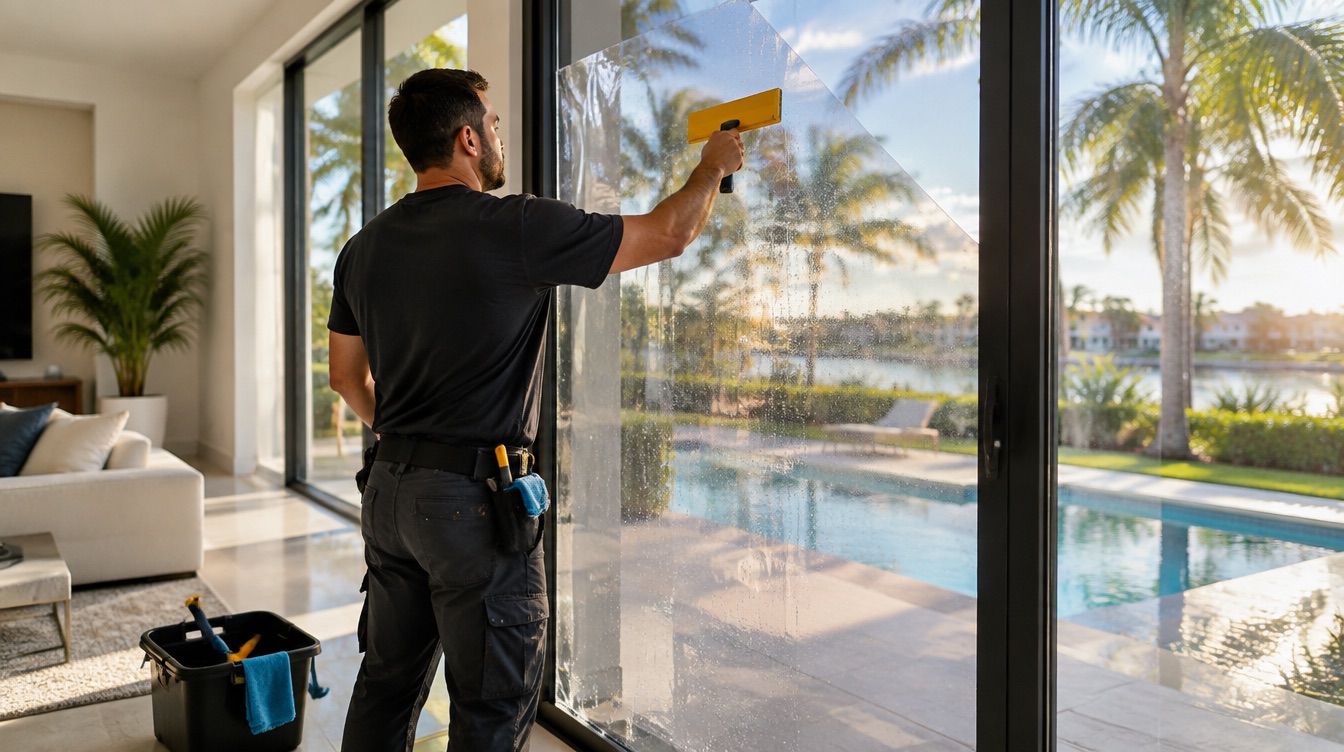
Tint Station installs residential window tinting on site at homes and condos across Broward and Palm Beach counties from its Deerfield Beach shop at 236 SW 12th Ave. Ramsey comes to the house for a free estimate, holds film samples against your own glass, and installs heat-rejecting ceramic, dual-reflective, frosted or clear safety film in a day, backed by a lifetime manufacturer warranty.
How does residential window tinting keep rooms cooler and lower the cooling load?
Residential window tinting is a film bonded to the inside of your existing windows that stops solar heat at the glass before it gets into the room. In a South Florida house, the windows are where most of the afternoon heat comes in. A west-facing family room with sliding glass doors can run several degrees warmer than the rest of the house, and the air conditioner runs all afternoon trying to catch up.
Heat-rejecting ceramic film rejects the majority of infrared heat while staying nearly clear, so the room cools without going dark. The U.S. Department of Energy lists window films among energy-efficient window attachments that cut heat gain on existing windows without replacing them. Less heat at the glass means a lower cooling load, a thermostat that holds its setting and rooms that feel the same from one side of the house to the other.
The rooms that benefit most are the ones you already avoid at 3 PM: the kitchen with the west window, the bedroom over the garage, the lanai with floor-to-ceiling glass and the upstairs loft. We meter those windows first at the free in-home estimate, because they are where the film pays off in comfort every single day.
Tint Station has installed residential window tinting across Broward and Palm Beach for 20+ years, from waterfront homes in The Cove in Deerfield Beach to country-club communities in Wellington and downtown condos in West Palm Beach. The shop is owner-run by Ramsey, who does the estimate and the install himself, so the person who recommended the film is the person who puts it on your glass.
Free in-home window film estimates. Call (754) 227-5156.
Free quotes • Lifetime manufacturer-backed film warranty • 20+ years of experience
Does home window film stop furniture, floors and art from fading?
Yes. Residential window tinting blocks up to 99 percent of ultraviolet light, which is the main cause of fading in hardwood floors, rugs, upholstery, artwork and photographs. UV is only part of the fading equation, since visible light and heat also play a role, but it is the largest part, and film removes almost all of it from every window it covers.
The same UV that fades a sofa reaches the people sitting on it. The Skin Cancer Foundation recommends window film as a sunscreen for your home and car, because ordinary residential glass lets most UVA through. Clear and lightly tinted ceramic films give you that protection without changing the look of the room, which is why we often film a nursery or a home office with a film you can barely see.
Expect honest limits. Film slows fading dramatically; it does not stop it forever, and a dark leather chair parked in direct sun for ten years will still change. What film does is take the daily UV dose off the floor, the furniture and the art so they age the way they would in a room with no window at all. Rotate the rug every few years and the floor under it will match.
Where fading hits first
South- and west-facing rooms, hardwood near sliding glass doors, dining tables under a skylight and anything in a bay window. Those are the panes we film first.
Homeowners who want the technical side can read the performance measures the International Window Film Association publishes: visible light transmission, UV rejection, infrared rejection and total solar energy rejected. We bring the specification sheet for every film we recommend to the estimate so you can compare them against your own glass.
Does residential window tinting give privacy at night as well as during the day?
Reflective and dual-reflective films give daytime privacy, and no solar film gives one-way privacy at night. That is the honest answer, and it is the one question we get asked most. A reflective film works like a mirror toward the brighter side. In daylight the outside is brighter, so neighbors see a reflection and you see out. After dark, with the lights on inside, the effect reverses and the room becomes the brighter side.
If you need privacy around the clock, the answer is frosted or decorative film, which obscures the view in both directions while letting light through, or a combination: dual-reflective film for the heat and daytime privacy, plus blinds or drapes at night. We say this at every estimate so nobody expects a mirror film to hide a lit living room at 9 PM.
Frosted film is the right choice for bathroom windows, a front-door sidelight, a glass shower wall facing a window, or the ground-floor bedroom that faces the sidewalk. It comes in full frost, gradients and bands, so a sidelight can be frosted at eye level and clear at the top to keep the light. Decorative patterns are cut to order.
For a street-facing window where you want to see out during the day, keep the heat down and not feel watched, dual-reflective film is the standard recommendation. The outer layer reflects and the inner layer stays low-glare, so the view from inside is clear and the view from the sidewalk is a reflection of the sky.
What do HOA and condo rules say about window film?
Most HOA and condo rules in Broward and Palm Beach care about one thing: how the glass looks from outside, and especially how reflective it is. Many associations prohibit mirror finishes and some specify a maximum exterior reflectivity or a particular shade so the building stays uniform. Very few prohibit window film outright, because a light ceramic film is nearly invisible from the street.
Check your documents before the estimate, or send them to us and we will read them. We carry film specification sheets and samples you can submit to the architectural review committee, and we have gone through that process with associations across both counties. Spectrally selective and light ceramic films clear most reviews; dual-reflective films need a look at the reflectivity rule first.
Condo owners have a second question: who owns the glass. In many high-rises the exterior glass is a common element, which can affect what film is allowed and who approves it. Interior-applied film does not alter the glass, which is why associations generally treat it as an owner improvement, but the approval still goes through the board. We will put the film details in writing for your submission.
- Read the exterior appearance and reflectivity rules in your HOA or condo documents.
- Ask whether approval is needed for interior-applied film; many associations require a simple form.
- Submit the film specification sheet and a sample; we supply both at the estimate.
- Choose a light ceramic or spectrally selective film where reflectivity is restricted.
- Keep the approval letter with your warranty record.
Where the association has an approved film or shade on file, we match it. Where it has none, we help you propose one that meets the rule and still does the job on your glass.
Can you tint sliding glass doors and high-rise condo units?
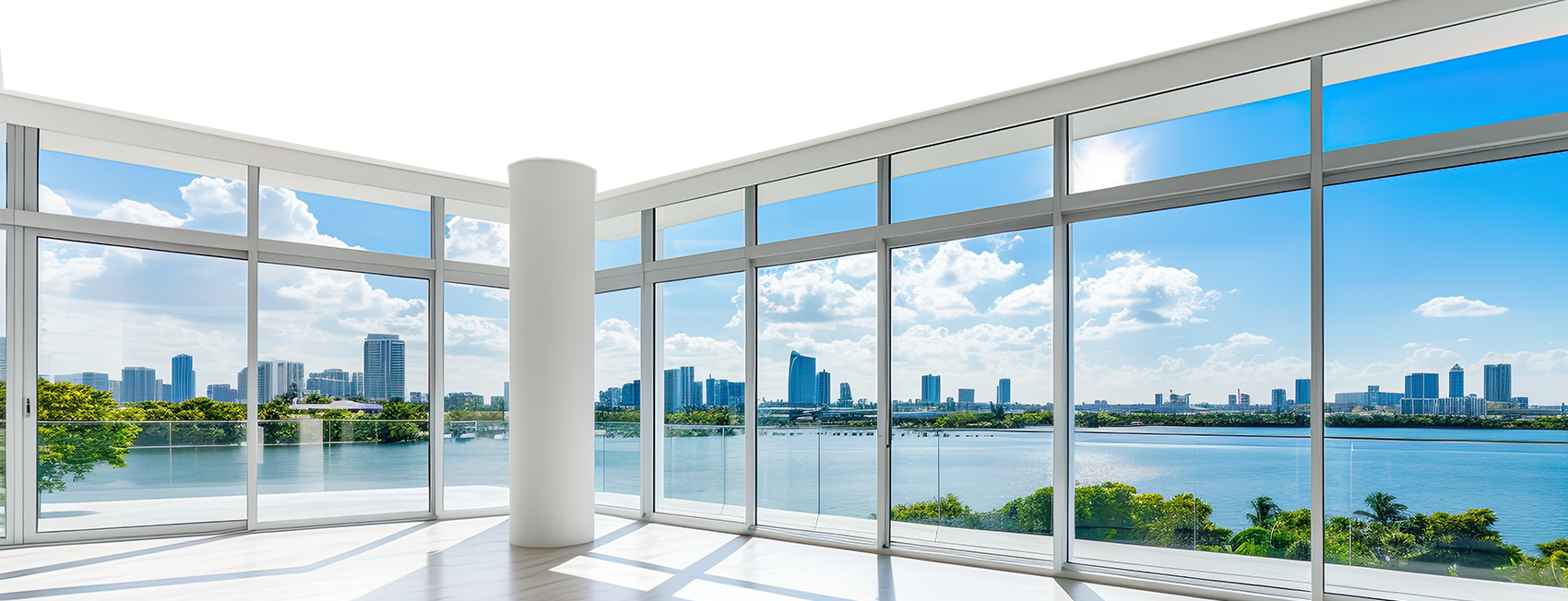
Yes. Sliding glass doors are the most common residential window tinting job in South Florida because they are the biggest single piece of sun-facing glass in most homes. The film is applied to the inside of each panel in one piece, trimmed to the frame and edge-sealed, so the door slides the way it did before and the view through it stays clear.
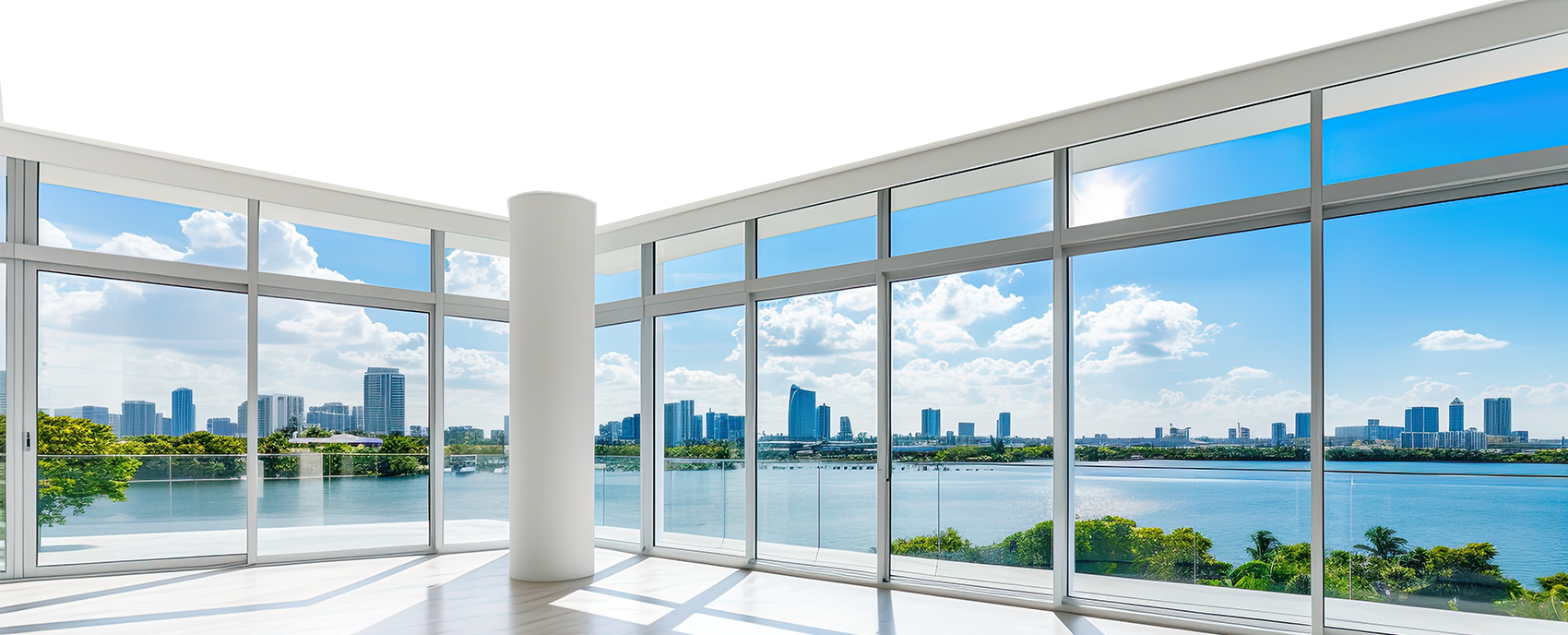
High-rise condo units have their own logistics. Floor-to-ceiling glass on a high floor takes more sun and more wind-driven heat than a ground-floor window, and the glass is often tinted or laminated already. We meter the existing glass first and choose a film compatible with it, because the wrong film on a laminated or heavily tinted pane can stress the glass. Then we schedule around the building’s elevator and work-hour rules.
Impact glass and insulated glass units deserve a direct answer. Film can be installed on many impact and insulated windows, and some glass manufacturers restrict which films are compatible with their units. We check the glass type at the estimate and recommend a film the manufacturer allows, and we tell you when the glass is better left alone. That honesty is why we are still here after 20+ years.
Skylights, transoms, French doors, bay windows and arched glass are all routine. Odd shapes are cut on site to a template. If a window has old bubbled film from a previous installer, we remove it and clean the adhesive before new film goes on, and we schedule the extra time when you book.
Which residential window film types do we install?
Heat-rejecting ceramic film is the default for most homes because it rejects the majority of infrared heat while staying nearly clear. Dual-reflective film adds daytime privacy for street-facing glass. Frosted and decorative films handle privacy and style. Clear safety film holds broken glass together. The table shows what each one does and where it belongs in a house.
| Film type | What it does | Appearance | Best for |
|---|---|---|---|
| Heat-rejecting ceramic | Rejects the majority of infrared heat and up to 99 percent of UV with no metal, so it does not affect cell or Wi-Fi signals | Nearly clear to light shade, low reflectivity | Sliding glass doors, family rooms, kitchens, nurseries, any window where the view matters |
| Dual-reflective | Reflective outer layer for heat and daytime privacy, low-reflective inner layer for a clear view out | Mirror-like outside in daylight, subtle inside | Street-facing windows, ground-floor bedrooms, west-facing glass |
| Frosted and decorative | Obscures the view in both directions while passing light; full frost, gradients, bands and patterns | Etched-glass look | Bathrooms, sidelights, shower walls, glass doors between rooms |
| Clear safety | Thick clear polyester that holds broken glass together in a sheet | Invisible | Doors and windows near the floor, children’s rooms, storm-season peace of mind alongside shutters |
Films can be layered by room rather than by house. A typical Boca Raton home gets ceramic film on the lanai sliders and the west windows, dual-reflective on the front bedroom, frosted on the master bath and nothing at all on the shaded north side. You film the glass that needs it, not every pane in the house.
Clear safety film deserves one honest line: it holds broken glass together and slows a break-in, and it is not a substitute for hurricane shutters or impact-rated glass. We recommend it where the daily risk is a ball, a dog or a burglar, and we tell you plainly when shutters are the answer for the storm.
What happens at the free in-home estimate and on install day?
Residential window tinting starts with a free in-home estimate, where Ramsey measures every window you are thinking about, meters the existing glass and holds samples up against your own panes in the afternoon light. You see the difference in heat on the back of your hand and the difference in look from inside and outside before you decide anything.
- Book the visit. Call (754) 227-5156 or request a quote online. Evenings and weekends are available, because the sun-facing windows are easiest to judge when the sun is on them.
- Measure and meter. Every pane is measured, the glass type is identified, and sun exposure is noted room by room.
- Samples on your glass. We tape samples of two or three films to the window and let you compare them from the sofa and from the yard.
- Written quote by room. You get a per-window quote, so you can film the sliders now and the bedrooms later if you prefer.
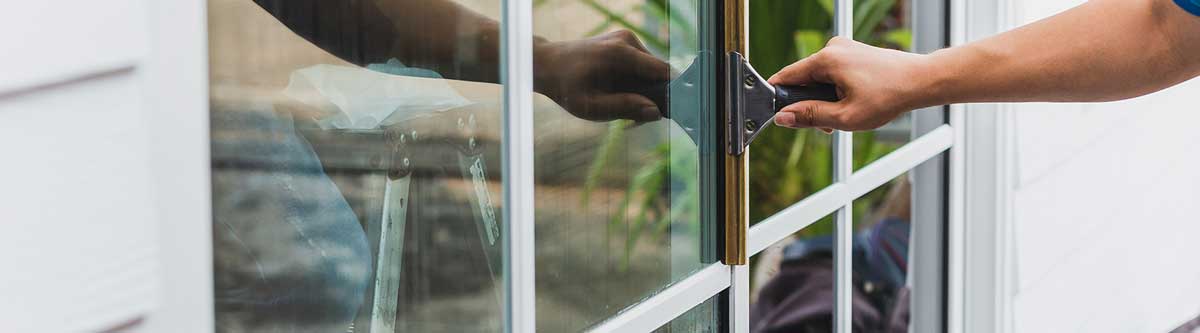
- Install day. Most homes are done in a single day. Furniture near the glass is moved or covered, each pane is cleaned and scraped, film is cut, applied wet, squeegeed and edge-sealed.
- Walkthrough and care. We walk every room with you, explain the cure period and leave written care instructions.
Film on home glass cures over a few weeks, longer than on a car, because the panes are large and the air inside is conditioned. Some haze or small water pockets in the first weeks are normal and clear on their own. Do not clean the film for thirty days, and after that use a soft cloth and an ammonia-free cleaner.
What does the residential film warranty cover, and what else can we do for your home?
Every residential film we install carries a lifetime manufacturer-backed warranty against bubbling, peeling, cracking, delamination and color change, with the terms set by the film manufacturer for the product on your glass. We explain those terms before you sign and register the film to your address when the job is finished. Our workmanship is backed by a shop that has been at the same Deerfield Beach address for 20+ years.
The warranty does not cover damage from outside the film, such as a razor scraper, an ammonia cleaner or a window broken for reasons unrelated to the film. Care is simple: wait thirty days before the first cleaning, use a soft cloth and an ammonia-free product, and keep sharp edges off the glass. If a pane is ever replaced, call us and we match the film to the rest of the room.
Many homeowners ask what else the shop does once they see the install. These are the residential services we most often pair with film, each with its own page:
- Residential window tinting: the service overview, with the film lines we carry for homes and condos.
- Home security systems: cameras, alarms and smart locks, often installed on the same visit as clear safety film on the doors.
- Home entertainment systems: TV mounting, surround sound and outdoor audio from the same shop that runs Detroit Sound Station.
We also tint cars in the shop; see car window tinting. Business glass is covered on the commercial window tinting page, and every city we cover is listed on the service areas page.
Where do we tint homes: Broward and Palm Beach County?
Residential window tinting customers across both counties are served on site from the Deerfield Beach shop, which sits on the county line just west of I-95 at the Hillsboro Boulevard and SW 10th Street exits. Below are the two county hubs and the city pages, each with the drive from that city to the shop so you know how close we are when you book.
Broward County residential window tinting
Waterfront homes on the coast, gated communities in the west and condos everywhere in between: 10 to 45 minutes from the shop via I-95, the Sawgrass Expressway or Military Trail.
Palm Beach County residential window tinting
Waterfront estates in Boca Raton and Jupiter, country-club communities in Wellington and Boynton Beach, and downtown condos in West Palm Beach: 7 to 60 minutes via I-95 south to exit 42.
Broward County: Deerfield Beach (right here in town), Lighthouse Point (about 15 minutes), Pompano Beach (about 15 minutes), Parkland (about 20 minutes), Coconut Creek (about 20 minutes), Margate (about 20 minutes), Oakland Park (about 20 minutes), Coral Springs (about 25 minutes), Fort Lauderdale (about 25 minutes), Tamarac (about 30 minutes), Plantation (about 30 minutes), Sunrise (about 30 minutes), Hollywood (about 35 minutes), Davie (about 35 minutes), Pembroke Pines (about 40 minutes), Miramar (about 45 minutes) and Weston (about 50 minutes).
Palm Beach County: Boca Raton (about 10 minutes), Highland Beach (about 20 minutes), Delray Beach (about 20 minutes), Boynton Beach (about 25 minutes), Lake Worth Beach (about 30 minutes), West Palm Beach (about 40 minutes), Wellington (about 50 minutes), Palm Beach Gardens (about 55 minutes) and Jupiter (about 60 minutes).
Because the work happens at your house, the drive mostly tells you how quickly we can get there for the estimate. We schedule in-home visits across both counties daily, including evenings and weekends, and we group installs by area so a Jupiter homeowner and a Palm Beach Gardens homeowner are often done the same week.
Serving residential window tinting customers from Deerfield Beach
Tint Station is at 236 SW 12th Ave, Deerfield Beach, FL 33442, just west of I-95 at the SW 10th Street exit, and serves all of Broward and Palm Beach counties. Open daily, 10:00 AM to 7:00 PM. Call (754) 227-5156 or request a free quote online.
Reviewed by Ramsey, owner and lead installer at Tint Station, with 20+ years of window film and vehicle customization experience. Last reviewed October 2026.
Frequently asked questions
Will residential window tinting make my house dark inside?
Not with heat-rejecting ceramic film, which is the film we recommend for most rooms. It rejects the majority of infrared heat while staying nearly clear, so the room keeps its daylight and the view. Only dual-reflective and darker solar films change the look noticeably, and you compare samples on your own glass at the estimate before anything is installed.
Can people see in at night after the windows are tinted?
With a reflective film, yes, when the lights are on inside and it is dark outside. Reflective film mirrors toward the brighter side, so it gives privacy by day and reverses at night. For privacy around the clock, choose frosted or decorative film on the windows that matter, or pair a heat-rejecting film with blinds or drapes after dark.
Will window film void my window manufacturer's warranty?
It can on some insulated or impact glass units, because a few glass manufacturers restrict which films may be applied. We identify the glass type at the free in-home estimate and recommend only films the manufacturer allows, and we tell you plainly when a window is better left alone. The film itself carries a lifetime manufacturer-backed warranty.
Do I need HOA or condo approval for window film?
Often, yes. Most associations regulate exterior appearance, especially reflectivity, and many require a simple form before interior film goes on. We supply the film specification sheet and a sample for your submission and recommend light ceramic or spectrally selective films where reflectivity is restricted. Frosted film on bathrooms and sidelights usually needs no approval.
How long does a residential window tinting install take?
Most homes are finished in a single day. The free in-home estimate takes under an hour, and on install day we move or cover furniture near the glass, clean and scrape each pane, then cut, apply and edge-seal the film room by room. Large homes with many sliders or high-rise units with building access rules may take two visits.
Does window film help with hurricanes?
Clear safety film holds broken glass together in a sheet, which keeps shards off the floor and slows wind and water once a pane fails. It is not a substitute for hurricane shutters or impact-rated glass and does not meet the Florida Building Code opening-protection requirement. We recommend it as a second layer and for everyday protection against break-ins and accidents.
Is the in-home estimate really free?
Yes. Ramsey comes to the house, measures the windows you are considering, meters the glass, tapes samples to your own panes and writes a per-window quote with no obligation. Evenings and weekends are available across Broward and Palm Beach. You can film the sun-facing rooms first and add the rest later; the quote is broken out by window.
How do I clean tinted home windows?
Wait thirty days after installation, then clean the film side with a soft cloth or microfiber and an ammonia-free glass cleaner. Never use razor blades, abrasive pads or scouring powders on the film. The outside of the glass can be cleaned normally. Haze or small water pockets during the first few weeks are part of the cure and clear on their own.
Call us today to book your free in-home estimate.
Open daily 10:00 AM to 7:00 PM • Owner-run for 20+ years