
Quick answer
Tint Station does car window tinting in the shop at 236 SW 12th Ave, Deerfield Beach, FL 33442, just west of I-95, for drivers across Broward and Palm Beach counties. You drop the car off, we cut the film by computer pattern, and most vehicles are finished in two to three hours with legal nano-ceramic, carbon or dyed film and a lifetime manufacturer-backed warranty.
What does car window tinting do for a car in South Florida heat?
Car window tinting is a thin, multi-layer polyester film bonded to the inside of your glass. It blocks ultraviolet light, rejects a large share of infrared heat and cuts glare. In South Florida, where a parked car sits in direct sun for most of the day, that film is the difference between a cabin you can touch and one you have to air out before you can drive.
Every film we install blocks up to 99 percent of UV, the part of sunlight that fades dashboards, cracks leather and burns the left arm of every daily commuter. The Skin Cancer Foundation describes window film as sunscreen for your car and home. How much heat a film stops depends on the material, which is why we walk through dyed, carbon and nano-ceramic options before you choose a shade.
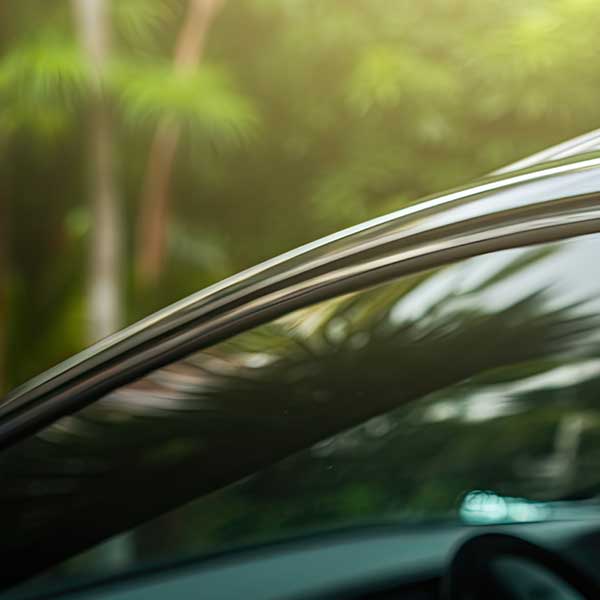
The practical payoff shows up every afternoon. Your air conditioning reaches a comfortable temperature sooner, so the compressor cycles less and the cabin stays even. Glare off wet pavement and off the cars ahead of you drops. Seats and the steering wheel stay cooler at pickup time. And from outside, a uniform shade on the side and rear glass gives you privacy for whatever is on the seat.
Key point
Ceramic car window tinting rejects heat without a dark shade. You can meet Florida’s 28 percent front-window limit and still feel a real difference on I-95 at 4 PM.
We have done car window tinting at this shop for more than twenty years. It is owner-run by Ramsey, who still cuts and lays film himself. Drivers from Deerfield Beach, Boca Raton, Pompano Beach and the rest of Broward and Palm Beach counties make the trip because the work comes from the same hands every time, not from whoever is on shift that day.
Free tint quotes for your car. Call (754) 227-5156.
Free quotes • Lifetime manufacturer-backed film warranty • 20+ years of experience
Dyed, carbon or nano-ceramic: which car window tint should you choose?
Nano-ceramic film is the right choice for most South Florida drivers because it rejects the most infrared heat at any shade, including the light shades Florida requires on front windows. Dyed film is the entry point and mainly adds privacy and a darker look. Carbon film sits between the two, with real heat rejection, a matte black finish and no signal interference. All three block up to 99 percent of UV.
| Film type | How it works | Heat rejection | Signal interference | Fade resistance | Best for |
|---|---|---|---|---|---|
| Dyed | A dye layer absorbs visible light | Low; it darkens the glass more than it cools the cabin | None | Lower; older dyed films can lighten over the years | Privacy and appearance first |
| Carbon | Carbon particles absorb infrared energy | Moderate to good | None | High; carbon does not fade or turn purple | Daily drivers who want heat relief and a matte black look |
| Nano-ceramic | Ceramic nanoparticles reflect and absorb infrared | Highest; rejects the majority of infrared heat even at light shades | None; works with GPS, 5G, satellite radio and SunPass | Highest; color-stable for the life of the film | Anyone who parks in full sun, Teslas and EVs, dark interiors |
Ignore the shade number alone when you shop. VLT, or visible light transmission, only tells you how dark the film looks. A 70 percent ceramic film can keep a cabin cooler than a 20 percent dyed film, because most solar heat rides on infrared, not on visible light. The International Window Film Association publishes consumer guidance on the performance measures that matter, such as total solar energy rejected and infrared rejection.
We keep samples of each film at the shop so you can hold them up to the sun in front of the bays and feel the difference on the back of your hand. That five-minute test settles most decisions. If you lease the car or plan to sell it in a couple of years, we will tell you when a carbon film makes more sense for you than ceramic.
One more honest note: the film is only half the result. A ceramic film cut by hand with a blade on the glass, or laid in a dusty lot, will look worse than a carbon film installed properly in a clean bay. Material and installation together are what you are buying, and both are done here.
What is the Florida window tint law for cars?
Florida sets its tint limits by window position and vehicle type in two statutes: Florida Statute 316.2953 for side windows and 316.2954 for the windows behind the driver. The rule that matters most is that your front side windows must let more than 28 percent of visible light through. The limits below are the ones we install to every day.
| Window | Sedans and coupes | SUVs, trucks and vans | Reflectivity limit |
|---|---|---|---|
| Windshield | Non-reflective tint above the AS-1 line only | Non-reflective tint above the AS-1 line only | Non-reflective |
| Front side windows | More than 28 percent VLT | More than 28 percent VLT | 25 percent or less |
| Back side windows | More than 15 percent VLT | More than 6 percent VLT | 35 percent or less |
| Rear window | More than 15 percent VLT | More than 6 percent VLT | 35 percent or less |
A few details catch people out. Film darkness stacks with the factory glass, so a film labeled 35 percent on glass that already blocks some light can land below the legal line. Our meter reads the finished window, not the roll. Mirrored and metallic finishes have their own ceilings: reflectivity of 25 percent or less on the front windows and 35 percent or less on the rear.
Florida allows darker tint for drivers with a medical condition that makes them sensitive to light, with a physician’s statement. You keep that exemption in the vehicle. We will install to the exemption once you have it, and we will not go darker than the statute without it. Read the statutes yourself at Florida Statute 316.2953 and Florida Statute 316.2954.
Why we install legal: an illegal front window is a traffic stop waiting to happen, and it buys you less heat relief than a ceramic film at a legal shade would deliver anyway. Drivers from Fort Lauderdale to West Palm Beach get the same answer from us. Pick the film by heat performance and pick the shade by the statute.
How does the in-shop car window tinting process work?
Car window tinting is done inside our shop at 236 SW 12th Ave, Deerfield Beach, never in a parking lot, because dust, wind and humidity are what put bubbles and specks under film. You drop the car off, and most vehicles are finished in two to three hours. Here is what happens in the bay.
- Drop-off and film choice. We confirm the shade for each window against the Florida limits, show you samples in daylight and note any old film that has to come off first.
- Glass prep. Every window is cleaned inside and out, the door panels and seals are protected, and the glass is scraped and squeegeed until it is free of lint.
- Computer-cut patterns. We plot the film for your exact year, make and model on a cutting machine, so no blade touches your glass and the edges follow the factory frit line.
- Heat shrinking. For curved rear windows and glass roofs, we shape the film with heat on the outside of the glass first so it lies flat with no fingers at the edges.
- Installation. The film is applied wet to the inside of the glass, squeegeed from the center out, and the edges are sealed. Rear windows go on as one piece, not in strips.
- Inspection and hand-off. Ramsey or the installer checks every edge under the lights, wipes the car down and walks you through the cure period before you leave.
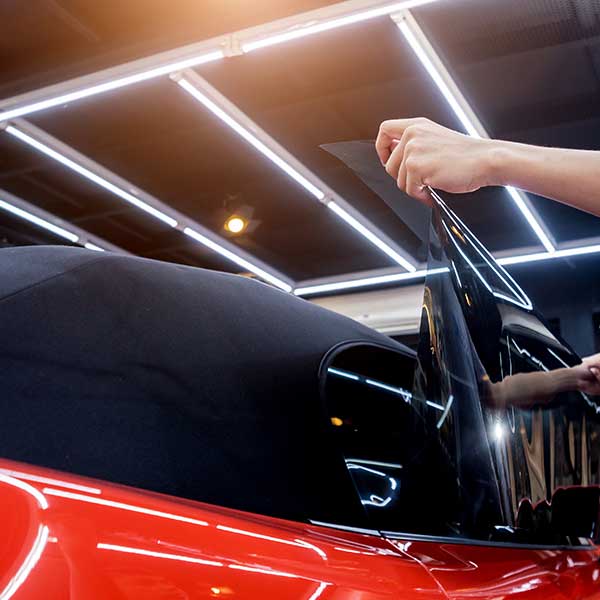
The cure period matters. Keep the windows up for three to five days while the moisture left under the film evaporates through it. You may see a little haze or a few small water pockets during that time, and they clear on their own. Do not pick at them and do not run the windows down early, because the edge can lift before the adhesive has set.
Old tint removal is part of the service when you need it. If your car arrives with purple, bubbled film from a previous shop, we strip it and clean every trace of adhesive before anything new goes on. Rear windows with defroster lines get extra care so the lines survive. Tell us when you book so we can set aside the time.
Which vehicles and fleets do we tint?
We tint everything from compact sedans to lifted trucks, Teslas with full glass roofs, cargo vans and dealership inventory. Twenty years of pattern files and hand work mean the odd shapes do not slow us down, and the shade rules are the same for every make: front windows legal, the rest to your preference within the statute.
Sedans, coupes and SUVs
This is the most common job in the shop: front doors to the legal 28 percent, rear doors and back glass to the shade you prefer, and a non-reflective strip above the AS-1 line of the windshield. Family SUVs from Coral Springs and Weston usually go darker in the back for the kids and the groceries, which the SUV rule allows.
Trucks and work vans
Pickups, cargo vans and passenger vans fall under the SUV rule, so the back side and rear glass only have to stay above 6 percent VLT, much darker than a sedan is allowed. Privacy film on a work van keeps tools out of sight in a jobsite lot. For contractors we schedule around the workday, with drop-off at the 10 AM opening and pickup before we close at 7 PM.
Teslas and EVs with glass roofs
A Model 3 or Model Y roof is one large sheet of glass, and the factory tint does little against infrared. We heat-shrink a single piece of ceramic film to the roof and treat the rear glass as one panel. Ceramic film keeps the cabin cooler while the car sits charging and does not interfere with the car’s antennas, key cards or phone key.
Dealership and fleet tinting
Dealers and fleet managers across Broward and Palm Beach send us vehicles in batches. We set a standing schedule, keep one film and one shade consistent across the lot, and turn cars the same day so they go back on display or back on the route. See the dealership and fleet tinting page for volume scheduling.
How do you care for new tint, and what does the lifetime warranty cover?
Caring for new car window tinting is simple once the film has cured. Wait three to five days before you roll the windows down. After that, clean the inside of the glass with a soft microfiber cloth and an ammonia-free cleaner. Ammonia and abrasive pads are the two things that shorten a film’s life, and neither is needed to keep it clear.
- Keep the windows up for three to five days after installation.
- Clean with a soft cloth and an ammonia-free glass cleaner.
- Never scrape the inside of the glass with a razor or a hard-edged tool.
- Haze and small water pockets in the first week are normal and clear on their own.
- Seat belt buckles and child seats can nick film if they slam against the glass, so be aware of them.
Every film we install carries a lifetime manufacturer-backed warranty against bubbling, peeling, cracking, delamination and color change. Modern carbon and ceramic films do not turn purple. That was a failure of old dyed films, and we do not sell film that does it. If anything is ever wrong with the film, bring the car back to the shop and we handle the claim with the manufacturer.
The warranty is registered to you and the vehicle when the job is done. Keep your receipt with the vehicle papers, and ask us about the coverage terms before you decide; we explain them in plain language rather than handing you a brochure. Our own 20+ years in Deerfield Beach are the other half of that promise. We are here when you need us.
Where do we tint cars: Broward and Palm Beach County?
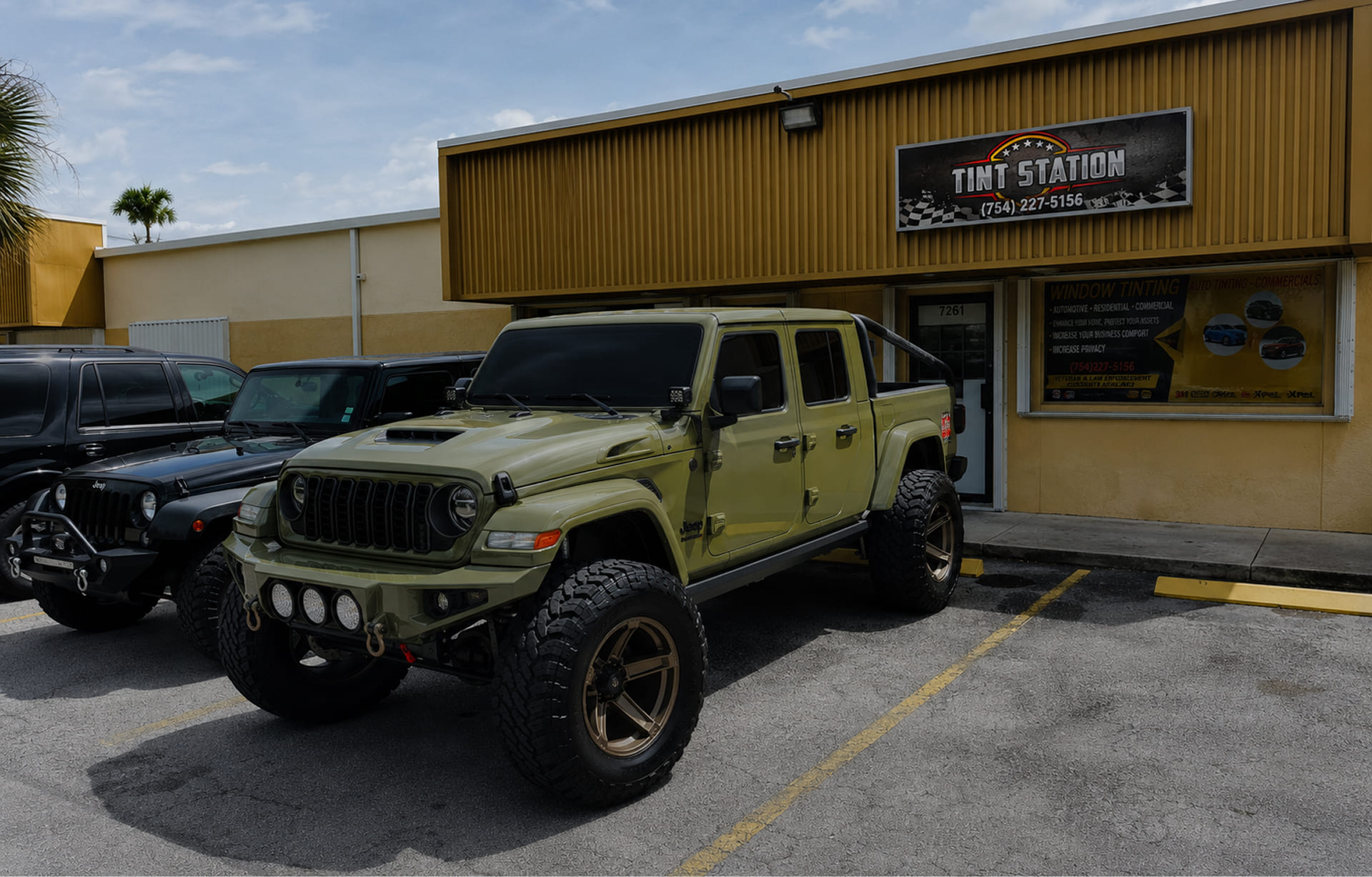
Car window tinting customers come to the Deerfield Beach shop from every corner of both counties because it sits just west of I-95 at the Hillsboro Boulevard and SW 10th Street exits, right on the county line. Below are the two county hubs and the city pages, each with the real drive time from that city to the shop.
Broward County car window tinting
Fort Lauderdale, Pompano Beach, Coral Springs, Hollywood and the rest of Broward: 10 to 45 minutes via I-95, the Sawgrass Expressway or Military Trail.
Palm Beach County car window tinting
Boca Raton, Delray Beach, Boynton Beach, West Palm Beach and north to Jupiter: 7 to 60 minutes via I-95 south to exit 42.
Broward County: Deerfield Beach (right here in town), Pompano Beach (about 15 minutes), Coconut Creek (about 20 minutes), Fort Lauderdale (about 25 minutes), Coral Springs (about 25 minutes), Plantation (about 30 minutes), Sunrise (about 30 minutes), Hollywood (about 35 minutes), Davie (about 35 minutes), Pembroke Pines (about 40 minutes), Miramar (about 45 minutes) and Weston (about 50 minutes).
Palm Beach County: Boca Raton (about 10 minutes), Delray Beach (about 20 minutes), Boynton Beach (about 25 minutes), Lake Worth Beach (about 30 minutes), West Palm Beach (about 40 minutes), Wellington (about 50 minutes), Palm Beach Gardens (about 55 minutes) and Jupiter (about 60 minutes).
Getting here from the north: take I-95 south to exit 42, Hillsboro Boulevard, the first exit south of the county line. Keep right off the ramp, turn right onto West Hillsboro Boulevard, then left onto SW 12th Avenue. From the south: take exit 41, SW 10th Street, turn left onto SW 10th Street, right onto East Newport Center Drive and right onto SW 12th Avenue. From the west, the Sawgrass Expressway becomes SW 10th Street and leads straight to the same turn.
What other automotive services pair with car window tinting?
Most cars that come in for tint leave with one more thing done, because the car is already in the bay and the door panels are already protected. These are the services we pair most often, and each has its own page with details.
- Automotive window tinting: the service overview, with the film lines we carry and the shade options for every window.
- Headlight and tail light tint: a light smoke or clear protective film on the lenses, cut to pattern, kept to shades that leave the lamps bright and visible.
- Dealership and fleet tinting: standing schedules, consistent film across the lot and same-day turnaround for inventory and work vehicles.
- Custom car audio: head units, speakers, amplifiers and subwoofers, installed by the same shop that runs Detroit Sound Station.
- Custom decals and wraps: vinyl graphics, color-change wraps and commercial lettering for work trucks and vans.
Bundling saves you a second trip. A commuter from Boca Raton who books tint and a sound upgrade for the same day leaves with both, and the fleet van from Pompano Beach gets its lettering and privacy tint in one visit. Ask when you call and we block the time so everything is finished before pickup.
Home or business glass? We also do residential window tinting and commercial window tinting on site across both counties, with free estimates and samples held up to your own windows. See the service areas page for every city we cover, or call (754) 227-5156 and talk to the shop directly.
Serving car window tinting customers from Deerfield Beach
Tint Station is at 236 SW 12th Ave, Deerfield Beach, FL 33442, just west of I-95 at the SW 10th Street exit, and serves all of Broward and Palm Beach counties. Open daily, 10:00 AM to 7:00 PM. Call (754) 227-5156 or request a free quote online.
Reviewed by Ramsey, owner and lead installer at Tint Station, with 20+ years of window film and vehicle customization experience. Last reviewed October 2026.
Frequently asked questions
How long does car window tinting take?
Most cars take two to three hours in the shop at 236 SW 12th Ave, Deerfield Beach. Full-size SUVs, vehicles with old film to remove and Teslas with glass roofs can run longer. You drop the car off, we cut the patterns by computer and install, and you drive home the same day. Keep the windows up for three to five days afterward while the film cures.
What is the darkest legal tint in Florida?
Front side windows must let more than 28 percent of visible light through on every vehicle. Behind the driver, sedans must stay above 15 percent VLT and SUVs, trucks and vans above 6 percent. The windshield may only carry non-reflective tint above the AS-1 line. Reflectivity is capped at 25 percent on the front and 35 percent on the rear. A physician’s statement allows a medical exemption.
Does ceramic tint really make a difference over regular tint?
Yes, and you can feel it on a sample in the sun. Dyed film mostly darkens the glass. Nano-ceramic film rejects the majority of infrared heat, which is where most of the warmth comes from, so a light legal shade of ceramic can keep a cabin cooler than a dark dyed film. It also holds its color for the life of the film and never turns purple.
Will window tint interfere with my phone, GPS or SunPass?
No. The dyed, carbon and nano-ceramic films we install contain no metal, so they do not block GPS, cell signal, 5G, satellite radio or toll transponders such as SunPass. Older metallic films caused that problem, which is one reason we steer passenger cars away from them. Tesla key cards and phone keys work normally through ceramic film.
Can you tint a Tesla glass roof?
Yes. We tint Model 3, Model Y, Model S and Model X glass roofs with a single heat-shrunk piece of ceramic film, along with the rear glass as one panel. The factory glass blocks UV but lets most infrared heat through, which is why the cabin bakes while the car charges. Ceramic film cuts that heat without affecting the car’s antennas or sensors.
Can I roll my windows down after tinting?
Not right away. Leave the windows up for three to five days so the water left under the film can evaporate and the adhesive can set. Rolling a window down early can catch the top edge on the seal and lift it. A little haze or a few small water pockets during that first week are normal and clear on their own without any attention.
Do you remove old purple or bubbled tint?
Yes. Old dyed film that has turned purple or bubbled comes off with heat and steam, and we clean every bit of adhesive from the glass before the new film goes on. Rear windows with defroster lines are handled carefully so the lines keep working. Let us know when you book, because removal adds time to the appointment.
Do you offer car window tinting for dealerships and fleets?
Yes. Dealers and fleet operators across Broward and Palm Beach counties send vehicles to the Deerfield Beach shop in batches on a standing schedule. We keep film and shade consistent across the whole lot, meet the Florida limits on every unit and turn vehicles the same day. Call (754) 227-5156 to set up volume scheduling for inventory, service loaners or work vans.
Call us today to book your free car window tinting quote.
Open daily 10:00 AM to 7:00 PM • Owner-run for 20+ years